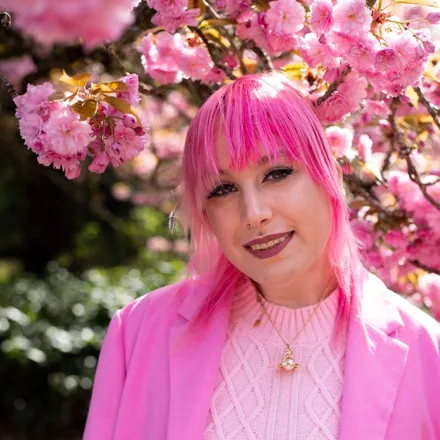
Ashlyn Graff
Online TherapyAccepting New Clients
About Ashlyn
I was born and raised locally in Washington state and currently based in Seattle, WA. I am white, cisgender (she/her), poly, and queer identifying. I graduated with my Masters in Clinical Mental health counseling from Walden University in 2021 and have been practicing ever since. I value interconnectedness, communication, and my relationships with those I love most. I believe in my authenticity being a tool to help others feel safe in theirs, and in forging my own life path based on my dreams. I have always wanted to use my strengths of compassion and critical thinking to make a difference in the world and found this field as a path to help me do just that. Diversity and social justice have been an important part of my ethos since the start of my career - this includes serving and advocating for LGBTQ+, BIPOC populations, and having focuses on the social model of disability and harm reduction techniques in my work.
When I'm not in my therapist role I love catching local shows and music, going on adventures near and far, being in any type of nature, playing with watercolors and other arts and crafts, cooking a new recipe, and snuggling my cat Thomas. Most of all, I love spending time with loved ones and engaging in community.
Out-of-Network Cost
$200 - 220 per session
Couples Therapy
How does couples therapy work, and what do sessions look like?
This is a broad question but I'll do my best to provide an answer that gives information with nuance. The way I provide couples therapy is collaborative and individualized to meet the needs of my specific couple or relationship. I describe my approach as structured but with flexibility. I most often use both Gottman Method and EFT with my couples. I start with an assessment phase to get to know the couple and the relationship in depth (I wouldn't be doing a great service to them if I treated them with less understanding of their context), then move on to providing skills and tools. When I say 'skills and tools' this does also integrate active emotional processing in the session while also providing frameworks the couples can use outside of the session. I love providing psychoeducation on what I am doing and why (your therapy and treatment is not a secret!), and I also try to integrate humor in my sessions. Couples therapy is very hard work for my clients and creating a space where it can be a really meaningful and even enjoyable process for my clients is really important to me as a clinician.
About Me
What inspired you to become a therapist, and what keeps you motivated?
I entered program when I was young to get a free Associates degree through my college, and I fell in love with my therapeutic approaches classes when I entered the social and human services program. It clicked that connecting with other people, bringing people together, and having compassion had always been my true strengths and compassions in this world. For what keeps me motivated, I heard a term "empathic joy" - the feeling of sharing my clients wins with them, and this is a huge motivator for me. On the opposite end, I also revel in being honored with sharing my clients pain with them, their dark moments, and being able to remind them they are not alone in this world. At the end of the day, being a person who engages in healing alongside others isn't something I have to 'stay motivated to do' - its a natural and inherent part of who I am.
Approaches · EMDR
How does eye movement desensitization and reprocessing (EMDR) work, and what do sessions look like?
EMDR is a therapy that focuses on treating symptoms of trauma and PTSD - but it does so much more than just that. We start with intake, assessment, and developing coping skills for distress that may arise during the process, then we move to the re-processing phases. In re-processing sessions, you pair focusing on a distressing memory and a negative belief about yourself with bilateral stimulation, and you focus on emotions, thoughts, and body sensations, and continue to 'go with it', continuing with this in new sets until the distress decreases and the positive belief increases. From a clinician perspective, EMDR is a streamlined modality for truly processing emotions and body sensations that have become stuck - it isn't just talking and replaying old information, but feeling those 'stuck' feelings so you can move past it and live with less pain in the day to day.
Location
Seattle, Washington
Specialties
AnxietyCouples TherapyIndividual TherapySelf EsteemTrauma and PTSDWomen's Issues
Client Focuses
AdultTeenElders (65+)WhiteBisexual
Approaches
EMDREmotionally Focused (EFT)Gottman MethodInternal Family Systems (IFS)Trauma Focused